Borrowed history
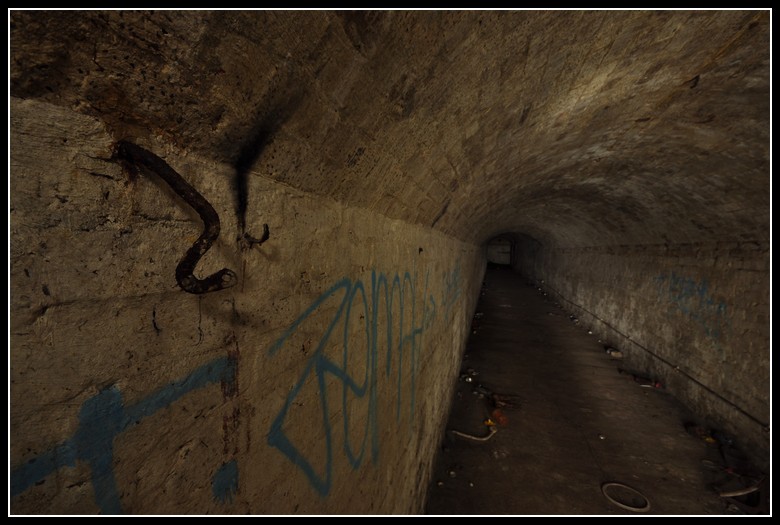
South Flank Casemates, Dover: During a new fear of invasion from
Napoleon III two new dry moats where added to the existing citadel
defences. The northern and the southern moat both had their own
casemates built. Between these there was also a defensive caponier
built, but sadly this was filled in during the 1960's by the Dover
Corporation and they gradually destroyed many parts of the Western
Heights.
The southern casemates are a lot larger than the northern casemates,
with eight separate rooms whereas the northern casemates only had six.
This was explored with silverrainbow..to get from the south to the north you have to crawl on hands and knees thru a small chalk tunnel then through a drainage pipe..also very small
On with some pics
Thats my lot..!
A blog with my Explores and Photographs from locations around the uk and Europe
Saturday, 19 May 2012
Friday, 11 May 2012
The union workhouse/asylum Chapel eastry
Bit of brief history on the workhouse/asylum the chapel was in us with...
Some pics of how it looks today!
Just a quick trip while waiting to meet up with some others
Eastry Hospital, formerly being the Eastry Union Workhouse, then Eastry Union Workhouse Infirmary (1871-1930) and Eastry Institution (1930-1948), before becoming a Hospital in 1948 until its final closure around 1997.
A workhouse was erected at the south side of Mill Lane in Eastry in 1835-6, the architect being William Spanton, who followed Sir Francis Head's model courtyard plan (which was also adopted by other Kent Unions such as Bridge, Cranbrook, Dartford, Dover, East Ashford, Malling, and Tonbridge). The new Eastry workhouse was designed to accommodate about 500 inmates.
The entrance block was to the north of the site. Two-storey blocks were arranged around a large courtyard to the south and a separate three storey infirmary block, together with detached fever wards was erected to the south of the workhouse in 1871. A chapel was built close to the road immediately to the north of the workhouse.
The former workhouse later became Eastry Hospital, a centre for the care of those with learning disabilities. The hospital has now closed and the site is being redeveloped; the infirmary block has been demolished along with most of the entrance block. The Grade II listed "Old Buildings" remain, along with the chapel which is sealed tight at the moment.
Some pics of how it looks today!
Just a quick trip while waiting to meet up with some others
Friday, 4 May 2012
Coulsdon Deep Shelter
This large public air raid shelter is one of four which were proposed
and built by Surrey Council at the beginning of WW2, the others being at
Epsom Downs, Ashley Road in Epsom and Kenley. After the war, the
shelter was used by a lense manufacturing company and later as a garage,
and most of the internal fixings and equipment seem to date from around
this time. The tunnels themselves are lined throughout in brick, and
have unfortunately become a dumping ground in recent years.
Visited with Obscurity St0rme and Space invader
Good explore and a very nice start to the day!!
Visited with Obscurity St0rme and Space invader
Good explore and a very nice start to the day!!
Sunday, 22 April 2012
Fullers earthworks Redhill april 2012
This was a revisit after a rather pleasant day underground....
Visited with SpaceInvader Obscurity and Storm.
A greyish, mineral-rich clay, fuller’s earth is well-known for its absorbent qualities and has many uses. Its best known use however is as cat litter, of which millions of bags are sold every year. Most of this is now imported from the Americas but until recently, fuller’s earth was quarried from the Lower Greensand strata at Woburn (Beds.), at Baulking (Oxon.) and at Redhill (Surrey).
On the Redhill deposit, the most successful quarry operating at the turn of the century was the Copyhold Works of the Fuller’s Earth Union Ltd, established c.1860-70. Initially supplying the woolen trade, demand later shifted to the growing chemical and comodity sector with customers in the 1920s-40s including the Southern Oil Company Ltd, British Glues and Chemicals Ltd and Price’s Patent Candle Co.
In 1954 the works, by now employing 780 men, were bought by chemical company Laporte Industries. Production was stepped up to meet increasing demand and a large factory consisting of kilns, granulators, blungers, silos and transit systems on several floors was built. A large quarry existed to the east and in the 1970s this strange landscape stood in for various alien worlds in the BBC’s Doctor Who series. In the 1980s, the Copyhold site was sending loose earths and packaged cat litter around the world.
By 1995, however, due to falling profits it was announced that the company would close 10% of its 100 plants. Copyhold fell victim the following year and the Laporte Group ceased fuller’s earth production altogether in 1997. After the production lines were switched off, the 119 acre pit was purchased for use as a landfill site by Biffa Waste Services and continues to take waste from across Surrey. The factory was for a while used as a waste transfer station but this was abandoned at some time in the last four years and the site is now derelict.
Trashed is not the word for the place but its still fun to take photographs of!Even if clambering up the top was a tad dangerous!!!
Visited with SpaceInvader Obscurity and Storm.
A greyish, mineral-rich clay, fuller’s earth is well-known for its absorbent qualities and has many uses. Its best known use however is as cat litter, of which millions of bags are sold every year. Most of this is now imported from the Americas but until recently, fuller’s earth was quarried from the Lower Greensand strata at Woburn (Beds.), at Baulking (Oxon.) and at Redhill (Surrey).
On the Redhill deposit, the most successful quarry operating at the turn of the century was the Copyhold Works of the Fuller’s Earth Union Ltd, established c.1860-70. Initially supplying the woolen trade, demand later shifted to the growing chemical and comodity sector with customers in the 1920s-40s including the Southern Oil Company Ltd, British Glues and Chemicals Ltd and Price’s Patent Candle Co.
In 1954 the works, by now employing 780 men, were bought by chemical company Laporte Industries. Production was stepped up to meet increasing demand and a large factory consisting of kilns, granulators, blungers, silos and transit systems on several floors was built. A large quarry existed to the east and in the 1970s this strange landscape stood in for various alien worlds in the BBC’s Doctor Who series. In the 1980s, the Copyhold site was sending loose earths and packaged cat litter around the world.
By 1995, however, due to falling profits it was announced that the company would close 10% of its 100 plants. Copyhold fell victim the following year and the Laporte Group ceased fuller’s earth production altogether in 1997. After the production lines were switched off, the 119 acre pit was purchased for use as a landfill site by Biffa Waste Services and continues to take waste from across Surrey. The factory was for a while used as a waste transfer station but this was abandoned at some time in the last four years and the site is now derelict.
Trashed is not the word for the place but its still fun to take photographs of!Even if clambering up the top was a tad dangerous!!!
Subscribe to:
Posts (Atom)
London 2021 ish
My last entry from the world or Urban exploring, im done and have been years really, so these are the last pics i have stashed away on my ...
-
This building was up until 1998 The Holy Cross Roman Catholic school a voluntary aided school for boys and girls. It closed its doors in 1...
-
Right very well known hospital now houses ,well the main hospital it's self is now houses what is left is beechwood house which was a sc...
-
"Hudson's Bastion is the most complex of the 19th Century defences in Dover Castle's East Ditch. It comprises the fortified ba...